Tuesday, 13 May 2014

The Planning Cycle

The Planning Cycle

 Reflecting on your work and meeting the NQS


Here at Smarty Arty our job is to make life easier for all educators. We make a range of products to help you meet the requirements of the NQS and the EYLF, but through this post we are going to look at the planning cycle so you can evaluate your own planning and see if you can see the flow or the cycle in your planning.

Through NQS 1.1 Each child’s current knowledge, ideas, culture, abilities and interests are the foundation of the program. Can you see this in your program? Do you have a place where you have observed a child's interest/ideas or abilities and show how you have enhanced, supported, or expanded on their current interests or knowledge.

Can you see if you look back over your planning for a period of approx. 6weeks that you show every child is included as part of your planning, and you can see how each of those children have been supported in their learning or challenged in their abilities allowing them the opportunity to grow?

Does your planning show evidence of all different types of learning for each child including exploring their own identity, experiences in culture and community events, growth in their learning and does your planning show their voice? Meaning by reading it can you see the different children, they way they act and react and different stages of their development scattered throughout the pages of your planning.

Does your planning show routine and a familiar cycle that children can grow from and gain the most out of their learning experiences from having a secure and familiar foundation.

Is your planning available for parents to see when they drop off or pick up. Is there communication with your parents? Now I know lots of parents are busy and sometimes it might seem a lot of work if no one seems to look, but even if it is only you who reads and sees the pages of your planning, still you can look back and see the growth of the children you have nurtured, you can see the difference you have made and the evidence is in these pages and what we as educators are partly assessed on when the time comes.

Do you have a place in your planning that is your voice, your reflection on the day/week. An honest account of what worked, what didn't and things you want to do, ideas you have for the children, and your plan ahead on how you are going to get there.

Can you see or do you have links from your planning back to the EYLF? Do you offer a range of activities that provide and extensive and holistic approach to a child's learning? How do you reflect on the activities on offer or the activities the children have access to?

If you can see all these things evident in your planning, then you can prove that you are meeting the NQS 1.1. Through going through this blog and assessing your planning and seeing all these things you are already critically assessing not only your planning cycle but the program and planning you have for the children.

If you can't see all these things.......don't worry we are here to help. We have built a yearly planner that covers all of what we reflected upon above. There is places to put what you can see the children are interested in or planning you have in place to challenge and enhance their learning, then you can show from that how it progressed, the children's voices our planner is structured but flexible to allow all of this to be shown.

There is a place for regular routines, outings, and it's all in a book that is easy to take everywhere with you, and easy to display for parents to see.

We have sections where it shows the activities you had on offer today, a place to write notes that parents have told you, or a place they can write on too. Your premises checklist is also included.

Then we reflect and connect. we have a reflections place where you can write a few sentences about the main focus of the day or a special little something about each child, and an easy access EYLF section available to tick or highlight and expand if needed.

Finally pictures are worth 1000 words we even have space for weekly photos, or art work if you want. There is even a forward planning area, where you can write up your ideas, resources you might want or other things to extend on something you have seen.

But while it sounds extensive...and it is.....it is EASY, and not time consuming like you may think. Using this planner, planning takes only a few minutes a day 5-10 min tops.

And we not just sell a resource and forget about it. I am always happy to help and provide support, via phone or email in regards to making the most out of your time and planning. If you live close by I can even pop in if you really need me.

So if our yearly planner is something you need you can find it under our Childcare Planning Tools on our website.

Feel free to ask questions, or post your comments below. Childcare is an important part of our greater community. One that comes under constant review and criticism, and united we need to help support one another and provide the best care possible to the children of our generation.

Sunday, 16 March 2014

Exposure..............It's all about Exposure !!


Being a child should be all about fun. There is a great push to learn, learn, learn these days and while learning along the way is important, this is the time when learning should be all about fun.

No pressure, no expectations.......just exposure.

I hear a............. What do you mean by that?

Well children will all have different interests and all have different strengths, and it is our job as Educators and as parents to help them achieve their full potential, but this does not have to be done at the sake of enjoyment.

To me it's all about exposure. A child who has heard and seen something several times will know more about it that someone who hasn't. No one is too old or too young to be involved and each person will take something different from the experience.

This is where the no pressure, no expectations come in.

If you place for instance, a basket of coloured counters out, will all children play with it? Maybe....
Will all children do the same thing.........most probably not
Will all children learn something...............yes.
Will they all learn the same thing from the experience............no.

And that is a good thing. Even in a mutli age group all children can have access to the same resources and gain skills and knowledge through their exposure.

I 1 year old..............learning from this experience, may simply be that these counters are colourful and although they look good, they don't taste good and I don't eat them.

A 2 year old................learning maybe that these round counters roll when I throw them on the ground, and they are really hard to pick up when they are flat, but if I throw them, I need to collect them too.

A 3 year old................learning may be, I am smart and I know that there is red counters, I can collect all the red ones. I am clever, what colour is this one?

A 4 year old.........................learning may be, you can make pictures out of anything including these counters. Can you see what I have made.

A 5 year old.......................learning may be grouping the counters my size or colour, counting how many of each colour they have, or even counting out counters to share evenly with their peers......

and they can do this all because since they were 1, they have had exposure to counters, they have learned from their peers, what else you can do, and they have conversed with their educator and parents and each time broadened their knowledge of what we can do with these round things called counters. This is all a natural progression and fun, because there was no expectation that the group of children were going to learn how to count to 10 or the colour green.

Each child had access to the same materials and their peers and the educator, they had access to the wealth of knowledge around them, and found it fun and interesting because it was at their own development stage, and their own interest.

Now sure as the educator, it is your job to enhance and use those teachable moments, but most times those teachable moments, are those moments with you. Your conversations, that is why I think it is also important for educators to be a part of the play.

For example if you are on the ground with the children playing with counters you can see if the baby is thinking they are good food, and the baby can see your facial expressions, saying yuk, they don't taste good !!
 You are there to help the 1 year old find the pieces they dropped and watched them roll, and offer support when picking up the little pieces becomes a little frustrating.
You are there to high five little Miss 3 because she knows the colour red and you are there to answer her when she asks what colour is this one?
You can make pictures with master 4, and be there to photograph his masterpiece and help redirect the baby from messing his wonderful picture,
And you are there to listen and help your 5 year olds count and group and show you all that they know, you can even ask them if they would like to add some paper and pens to write down their discoveries or you can write it down for them................

I am hoping you can now see that learning is fun, no matter what the age, and learning is all about exposure....................and most importantly exposure to YOU !!

Monday, 6 January 2014

New Years Resolution No. 1 "Cleaning the Windows to my Soul"

New Years Resolutions.

Are they a waste of time? Lets be honest most of us only ever stick to the half hearted ones for a few weeks. We give our selves this list of unrealistic demands and slap a date to comply on it.

Well this year, I have decided on making my new years resolution a year of growth, talking the things that are important to me, as a mum as a person, they were not the simple eat better, exercise more, make more money types of resolutions but something deeper, something that when I looked into the mirror and saw the windows of my soul, that I would be proud and feel accomplished, more at peace, more INNER PEACE.

So my New Years Resolution No. 1 starts in 2013. As a business owner, you read lots of blogs, facebook pages and the sorts, you mostly skim over these and take it all with a grain of salt.

 But there was something I read and saw of the course of 2013 that stuck with me, like a little screw slowly getting deeper in my brain. It was Ngaire from Brisbane Kids, who was doing some posts about taking more photos with you in it with your children, about losing her Mum early. Initially I thought, yeah I should do that, and looking back through the photos on the computer, there was basically none of me, and the ones that were there, the kids had taken, and I hated them all.
The thought slowly faded, until other one of her posts graced my newfeed about photos and how the kids don't care what you look like, (that screw winds in a little deeper) and later that day Master Jude (5) shoves an ipod in my face, takes a photo, smiles and says it's beautiful. And then it all started to hit me, I am so busy that I only take photos of the kids when we go somewhere, or it's something on at school like book week.

Although I am here I am absent in their lives, where are the little important moments. How can I be so blind by the one thing in live that gives me passion. I work from home to support educators around Australia and be here for my children, yet I am not there for them, not in the way that matters to them at all.

And no wonder I lost my spark??????????????????????????????

I lost my passion, my passion as a Mum for the moments of joy, of stupidness, of craziness, of happiness, so I slowly stopped sweating the little stuff, understanding that I could not control everything, but taking pleasure in the things I could control like.......

who cares if dinner it not done until 7.40?????
I started to spend some time talking, playing and reading rhymes even if that means bed time was later.
I don't constantly say we will do it tomorrow, we NOW fit it in that day.
I started telling them stories about what I did as a kid and teaching them how to play games like trouble, throwing a Frisbee, and doing the hand clapping thing to Miss Mary Mack, Mack Mack.

I started treating myself like a person, not a 24/7 answering service to my business, I had managed to exploit myself and I don't know why. I mean I know it's OK for every other business to be shut outside of business hours, why did I think I should run myself into the ground. I have always told other educators to look out and look after themselves first, because if you compromise on who you are you will not be the best educator that you can be..... or the best Mum you can be......

So that is my new years resolution No.1, a work in progress, not set time frames to comply, just taking each day's moments and capturing them together.

Monday, 22 April 2013

Templates or not ??

In this day and age childcare has evolved quite a bit. Some things for the better - something's  I am not so sure of.
We went through a stage of eliminating all the risk and while I can see some people are slowly changing to incorporate this educators are still held back by scheme and centre policies.

Another thing in recent times and I myself have copped flack for this is the use of templates or black line masters as some of you might know them. Some schemes and childcare centres frown upon these tools  and exclude the use of them. well like I have said before and will say again, it's all about balance.
Do I think that children should only be taught from templates? NO!
Do I think educators/children should use and have access to templates? YES
WHY?? Here is my answer.

Free play and design art is a wonderful experience, allowing children to discover and create through exploring different materials is definitely a wonderful process but I believe it is also our job as educators to teach, to show by example how to create and do something specific and I believe this process is also IMPORTANT. - after all we don't give someone a car license without training and teaching them, or the materials to build a house and say have a go build me a house.

Everything we do in life requires training and a certain amount of structure- templates fall into that category. They are a teaching tool, an example for children to learn from and develop skills which they will be able to take and adapt from one project to another. Through the use of templates and structured activities children can develop specific skills and learn that sometimes product is just as important as process. Skills like colouring inside the lines, writing letters and words are all developed with the help of templates or BLM. I know there are many who might disagree but we are building little people who need to learn balance. By promoting the use of these templates, I also don't think we should take away choice or individuality. I do think it is sad when you see a class room full of the same project that all looks exactly the same. I think when it comes to specific project work where a set of instructions or a process is followed I think choice and personalities should still shine through. Example making a Mother's day photo frame, children can choose decorating items, colours etc. everyone is still making a photo frame but the look can still be as individual as they are.

More specific still take our art pack 4 flowers - this pack contains - flower pieces - buttons - vine templates. The basis of the pack is to count to 4, make a sheet with 4 flowers on it. Now where the children put their flowers - is their choice - how they build their flowers, draw, stick on, multilevel flowers, big or small flowers - their choice - the colours they choose - their choice and while each child will make a sheet with 4 flowers using a template, creativity and individuality is still supported while learning and following instruction and creating something specific is still being achieved.

Even after doing this you might find children like extending this themselves with free collage, by making and drawing lots of collage flowers - which they may even count or ask you too.

Each time we develop a pack we take into consideration all these things.
We look at what learning is occurring or what learning we would like to be achieved.
-How can we do that while supporting choice creativity and a child's individuality.
- How can we help cement this learning through different types of visual, kinaesthetic, audio etc
-How can we make this easy for the educator/parent so they have time to converse and support children's learning instead of looking for materials or trying to cut everything out.

Myself as an adult use templates everyday, I love colouring, designing and I LOVE creating but without the knowledge and experience I have gained throughout my everyday life, I would not be able to do what I do today. Instructions, specific process, products all form a part of every persons life, so why exclude this from the next generations early years learning preparation?


Sunday, 31 March 2013

Craft Kits – 5 Reasons to Choose a Pre-Made Craft Project

Craft kits are a fantastic way to get creative with your children. No matter how little time you may have, a pre-prepared art kit is ideal, as you know that everything you need is included and ready to go. Full instructions are provided for your kids to follow, so you don’t need to be a great artist yourself – just get involved! Craft kits can be very economical too, as you don’t have to buy large quantities of each material and there is no waste. Why not set aside a day a week to complete an art project with your child? The Smarty Arty’s monthly art pack delivery gives you 4 new art packs home delivered each month, exploring various themes and often tying in with upcoming celebrations like Easter or Australia Day.

1. Age specific projects to stimulate creativity

Grow your child’s creative streak with a craft activity appropriate to their age. Craft packs from the Smarty Arty art store are suited to children from 18 months of age, with different kits available to suit to each age group. Art sets are designed to target specific skills and learning outcomes, so choosing a compatible kit and completing the project is easy.

2. Craft packs make learning interesting

Your little one doesn’t need to know that they are learning while having fun with a craft kit. Art and craft assists children’s learning retention. Through art, kids not only see and hear sounds, numbers and words, but they connect with concepts through a hands-on approach to learning.

3. Art projects help to develop cognitive skills

Art participation and education supplies your child with cognitive skills, that is, learning skills that are vital to success in your child’s schooling and life in general. Focussing on a task, not being distracted and multi-tasking are very important learning outcomes that can be learned through partaking in craft projects. Art and craft provides the perfect fun and relaxed environment in which to practise cognitive skills, in turn heightening their development.

4. Fine motor skills increase through art material manipulation

The actions of threading beads, cutting paper or pinching and rolling play dough assist with the development of fine motor skills. Without effective fine motor abilities, key proficiencies such as handwriting cannot be attained. From an early age, Smarty Arty’s craft packs will hone your child’s fine motor skills and you will see a marked improvement in your child’s ability to do more things for themselves. This is why regular craft involvement is so important for young children.

5. Pre-made craft kits save time and money

Craft packs contain everything you need to complete a set art project with your child. This means that you don’t need to spend time researching an age-appropriate activity. You don’t need to search for the art supplies online (usually having to buy a lot more than you actually need!). You don’t even need to prepare the materials. You can launch straight into an art project whenever the mood strikes. And you’re never left with unnecessary materials that you have no use for at the end!

Tuesday, 26 February 2013

Creativity for Kids - Ways to Grow Your Child’s Creative Streak

Heightened creative intelligence leads to increased resourcefulness, or the ability to meet challenges in a variety of ways. As children develop imagination, they learn to believe in their own instincts and unique talents and they will grow a confident approach toward problem solving. In nurturing creativity for kids, you need to let go a little and leave artistic and inventive decisions up to your child. You can, however, stimulate imagination by asking provocative questions concerning the why’s, how’s, and what’s of objects and situations. It is vital that you be available to offer reassurance when artistic projects don't go to plan and praise your child for trying as well as finishing the task.

Instructional projects to stimulate creativity for kids

Sometimes, real instruction is needed. Your child needs to know how to use the art materials you have supplied – your demonstration and suggestions will assist greatly in your child’s first efforts at drawing and painting, and your supervision is unquestionably necessary in using many of these materials.

Encourage exploration to grow your child’s creative streak

Motivate your child with comments such as “How interesting; you created a secret passage-way with the blocks.” or “The way you mixed different greens for leaves makes your tree look very real.” Stimulate inventive, autonomous thinking by posing questions. With creative projects, avoid giving your child specific instructions. For instance, when making a sun catcher say, “I wonder what material the sunlight would shine through the best. What do you think?” Give merit to your child’s different ideas and opinions. Encourage creative thought by using phrases like “Well, that is definitely one way of looking at it,” or “What a GREAT idea, I’ve never thought of that before!”

Resist perfectionism in creativity for kids

You may be able to do the job faster and better, but this is all about your child learning to do things for themselves and exploring their own creativity. Resist taking over your child’s project and, likewise, do not add ‘finishing touches’ to make it perfect. The creative process is far more important than the final result. With practice, creations will improve and we need to respect the learning that occurs while an activity is taking place. A wonderful way to show respect for your child’s creative effort, thus encouraging further creativity, is to exhibit your child’s stories or artwork on refrigerators and the walls of your home. Kids also love to see their handiwork on display at their parents’ workplaces.

Explore art supplies online to suit every age group

Art stores are so much fun to explore. You may be surprised at the quantity of art materials that even a baby can manipulate and delight in (with adult supervision, of course!). Under the age of one, a child will take great enjoyment in scribbling on a large piece of butcher’s paper with a junior crayon. Your child can quickly move on to coloured pencils and chalk, and, by age two, water-based felt-tip pens. Around the age of two, your child will have the skills to start painting. Make sure you protect clothing with an art smock and the area where your child is painting with newspaper to avoid a big mess. Finger paints and paint pads are great as a starting point, moving on to easel painting with chubby paint brushes and paints as they get older. Also around the age of two and as your child’s sense of touch develops, you will find that your child loves to pummel, roll, and squash play dough. Start with hands only, and move on to using tools to manipulate the dough as your child develops great fine motor skills. Whilst it is very difficult at times to take a step back and let your child do something on their own, creativity for kids is encouraged greatly in doing just this. Smarty Arty has all of the art and craft supplies you will need to get back to basics. Go on an adventure of wild imagination with your child to stimulate that creative streak and have a wonderful time in the process.

Thursday, 14 February 2013

Food, Food Glorious Food..........or maybe not the case when it comes to kids and their lunches.

There has been talk in the media lately on the quality of school and childcare lunch boxes, and what the parents think about them....

I sit on both sides of the fence. I can see the benefit of having a healthy lunch, I really don't think any parent would argue with that, but I also know how hard it is to always pack ALL Healthy, and I am not afraid to say that I don't think there is anything wrong with a muesli bar with a squiggle of chocolate on it, or a piece of homemade cake.

I as a parent DO get annoyed with my child coming home resighting comments that his kindy teacher has said, don't you listen because there is not allowed any chocolate at kindy. (we are not talking a chocolate bar, just a squiggle of chocolate). Use those ears on your head.

Mornings are busy, getting ready, breakfast, feeding our brood of animals and making lunch. I make master 4's kindy lunch, but the older two make their own, unless they are running late. And I can tell you that I can fill a lunch box with all healthy food in the beginning of the week, but towards the end, well it does come down to adding the odd meusli bar or 2.

Coming from a FDC background, I liked my daycare kiddies to eat healthy, and I would model this behaviour as I sat and ate lunch with them. I provided food, so having healthy food was easier when I had the time to prepare it all. The children and I would often use cooking as our learning experiences and I would use this to encourage children to try/taste new food, but even running a childcare, the children had balance.

 Food is an important part of our life and I think as both parents, teachers and educators alike we should also be careful on how we aproach the subject. We certainly don't need to be making our children feel guilty over eating a muesli bar or a homemade cake.

Everything comes down to balance, as long as children have a balance of good, mostly healthy and  a small amount a biscuits, or cake or other. And again balance on their activity level, eg, include some form of active play during their day. Then I think there is nothing wrong with children having their cake too.

I also beleive it is a parents responsibility to decide what their children should eat and again for them to alter the balance of their food if they think their children need to have a more healthy life style. This certainly starts at home, and most educators would know you can educate the children all you like but the parents are responsible for buying and preparing the food, if they choose junk, then the children have little choice in the matter. I also think in cases like these it makes very little difference to a child's overall health when educator/teacher focus and make a child eat only healthy food when at home, their is no healthy food in sight. In cases like this, putting so much emphasis on healthy eating and such a negative impact on unhealthy eating can also cause disturbing self image and self esteem problems, and can also lead to eating disorders as well.

My approach is enjoy food, all food. Eat the colours of the rainbow, and a little rainbow cake ever now and again. As a family we all like to try new food, and all my children enjoy the experience of cooking. To end on a lighter note, I thought I would share our new favourite salad.

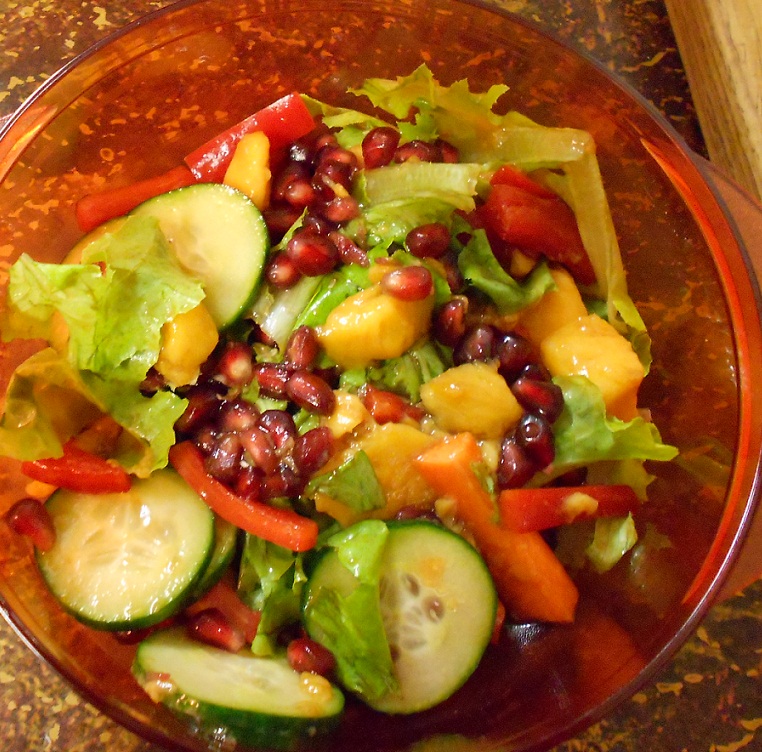
Mango and Pommigratite Salad.  Recipe is an original from my husband, Kim.
 
Ingredients
1 mango diced
Half of a pomegranate seeds tapped, rind disguarded.
Half a lettuce, sliced cucumber, thinkly slices carrot.
Add together and mix throughly.
Dressing
1  tablespoon of balsamic vinegar
 3 teaspoons of honey,
1 teaspoon of olive oil
mix together and drissle over.
(we also love elderberry dressing on this salad, but this is only available online through http://www.ashboltfarm.com/ef_main.htm )